

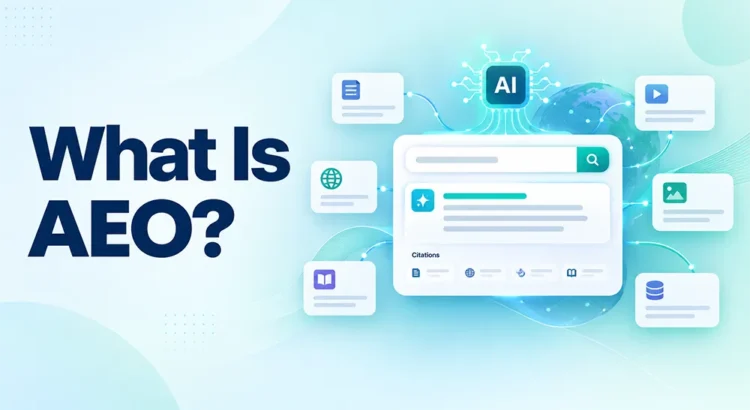
Answer Engine Optimization (AEO) is becoming an important part of digital marketing as people increasingly use AI assistants and search engines to find direct answers.
Traditional search results help users discover webpages, while AI-powered platforms can summarize information, answer questions, and recommend sources within a conversation.
AEO helps businesses make their website content easier for these systems to understand and potentially reference. It focuses on clear answers, relevant information, technical accessibility, and content credibility.
Although AEO does not replace traditional SEO, it helps businesses adapt to changing search behavior. This guide explains how AEO works, its benefits, practical optimization strategies, and ways to measure performance.
Table of Contents- What Is Answer Engine Optimization (AEO)?
- Why Is AEO Important?
- How Do Answer Engines Work?
- Major Answer Engines and AI Search Platforms
- Types of Answer Engine Optimization
- Answer Engine Optimization Strategies
- AEO vs SEO vs GEO
- How to Measure AEO Performance
- Common AEO Mistakes to Avoid
- Conclusion: What Is the Future of AEO?
- Looking for an SEO Expert for Your Business?
- Frequently Asked Questions About AEO
What Is Answer Engine Optimization (AEO)?
Answer Engine Optimization (AEO) is the practice of creating, structuring, and formatting digital content so search engines, voice assistants, and artificial intelligence platforms can easily read, evaluate, and use it to answer user inquiries directly.
Instead of competing purely for traditional webpage rankings, this approach optimizes information to serve as the direct source material for synthesized responses, conversational summaries, and targeted snippet displays.
How Does AEO Differ from Traditional Search Optimisation?
Traditional search optimization focuses on securing high positions on search engine results pages for targeted keywords, driving traffic primarily through organic website clicks. Optimization for direct answers shifts the primary goal toward providing immediate clarity and satisfying user intent.
While conventional methods emphasize backlinks, keyword placement, and metadata to capture clicks, answer-focused strategies prioritize factual accuracy, conversational phrasing, clear formatting, and structured data to ensure content is selected as the primary response.
What Is an Answer Engine?
An answer engine is a software platform or search interface designed to provide immediate, definitive responses to user queries rather than offering a simple directory of web links.
These systems extract relevant facts from indexed web pages, structured data repositories, knowledge graphs, and large language models to construct coherent answers in real time. Examples include voice tools, AI summaries, and conversational search assistants.
Key Components of AEO
Successful optimization relies on several interconnected elements that make web content easy for automated systems to evaluate and extract:
- Answer-Focused Content: Clear text that responds directly to a prompt within the first few sentences.
- Search Intent Alignment: Comprehensive coverage tailored precisely to informational, transactional, or navigational needs.
- Semantic Relevance: Conceptual relationships and contextual depth that help algorithms understand broader topics.
- Structured Data: Code markup that explicitly labels entities, facts, author credentials, and page elements.
- Content Credibility: Clear author transparency, original research, and verifiable facts that build source authority.
- Technical Accessibility: Strong crawling, indexing, fast page loads, and clean document structures that allow seamless content parsing.
Why Is AEO Important?
As online search capabilities expand beyond basic keyword matching, discovery habits are rapidly evolving. Users increasingly expect instant, synthesized answers without needing to navigate through multiple websites.
Changing Search Behaviour
Users increasingly ask conversational questions through search engines, voice assistants, and AI chat tools. Content that directly addresses these questions can better meet their information needs.
Improved Visibility in AI Search Results
AEO helps make website content easier for AI platforms to understand and potentially reference in generated answers. This creates additional opportunities for businesses to reach users beyond traditional search listings.
Brand Awareness and Authority
When a business is cited or mentioned in relevant answers, it can increase brand recognition and help establish credibility within its industry.
Zero-Click Searches and Organic Traffic
Some users find answers directly on search results pages without visiting a website. Although this can reduce clicks, appearing in answer features can still build awareness and encourage users to visit the site when they need more information.
Competitive Advantage in AI Search
Optimizing content for answer-based search experiences helps businesses adapt to changing discovery habits. Combining AEO with traditional SEO can support visibility across both conventional search results and emerging AI-powered platforms.
How Do Answer Engines Work?
Answer engines interpret questions, find relevant information, and generate direct responses. They may use search indexes, knowledge graphs, and AI models to understand queries and select useful sources. The exact process varies by platform.
Understanding User Intent and Queries
Answer engines look beyond exact keywords to understand what users want to know. For example, “best website design for a small business” indicates a need for recommendations, while “website design cost” suggests pricing information. Content that directly addresses these needs can be more useful for answer engines.
Crawling and Indexing
Search engines use crawlers to discover web pages and process their content for indexing. A technically accessible website with clear navigation, internal links, and indexable content makes it easier for search engines to find and understand its pages. Indexing does not guarantee inclusion in AI-generated answers.
Semantic Search and Entity Recognition
Semantic search helps systems understand a query’s meaning rather than matching exact keywords alone. Entity recognition identifies people, businesses, products, locations, and concepts. Clear terminology, descriptive headings, and consistent business information help establish what a page is about.
Knowledge Graphs and Information Retrieval
Knowledge graphs connect related entities and facts, such as a business, its services, and its location. Information retrieval helps answer engines find relevant material from search indexes, databases, and other sources. Accurate, consistent information can help systems understand relationships between topics and entities.
Large Language Models (LLMs)
LLMs interpret language and generate human-readable responses by identifying patterns and using available context. They can summarize information and explain complex topics conversationally. Some answer engines combine LLMs with search systems to access relevant information, including newer content.
Retrieval-Augmented Generation (RAG)
RAG combines information retrieval with AI-generated responses. The system retrieves relevant external information and supplies it to the language model as context for generating an answer. This can help responses incorporate current or topic-specific information, depending on the sources available.
Google’s guide to optimising websites for generative AI features in Search explains how Google Search uses RAG to ground AI responses in relevant web pages. It also outlines how established SEO practices support visibility in AI Overviews and AI Mode.
Source Selection and AI Citations
Some answer engines select relevant sources and display links or citations alongside their responses. Relevance, accuracy, clarity, and credibility may influence source selection, depending on the platform. Publishing useful, well-structured content can improve its chances of being considered, but indexing or ranking does not guarantee an AI citation.
Major Answer Engines and AI Search Platforms
Businesses seeking to optimize their online exposure must adapt their content strategy to suit the specific architecture of major answer environments.
Google Search, AI Overviews, and AI Mode
Google remains the primary gateway for web discovery, combining traditional organic listings with AI-generated features. Google AI Overviews aggregate real-time web results to present direct, multi-source summaries at the top of search results. In addition, interactive search features and featured snippets draw heavily from well-structured pages that answer questions directly.
ChatGPT Search
OpenAI has integrated native web search capabilities into ChatGPT, enabling the platform to answer current events and factual queries with real-time web references. The system reads online sources, synthesizes relevant findings, and displays direct attribution links within its conversational UI.
Google Gemini
Gemini serves as Google’s multimodal AI assistant, powering interactive query handling across consumer apps and web environments. It emphasizes conversational clarity, logical reasoning, and seamless integration with broader web knowledge networks to address complex user inquiries.
Microsoft Bing and Copilot
Microsoft integrates AI-powered search features directly into Bing and its broader Copilot system. Utilizing advanced OpenAI capabilities paired with Bing’s web index, Copilot synthesizes web content, cites external references, and offers interactive follow-up prompts to refine answers.
Perplexity AI
Perplexity operates as an answer engine focused entirely on research-backed query resolution. It processes user prompts by performing real-time web searches, synthesizing key findings into concise summaries, and placing footnoted citations alongside external web links.
Claude by Anthropic
Claude is designed to process complex instructions, analyze detailed documents, and handle nuanced conversational topics. When connected to live web search tools, Claude parses source material carefully to deliver well-structured, contextually accurate answers.
Voice Assistants: Siri and Alexa
Voice-activated platforms like Apple Siri and Amazon Alexa rely on concise, accurate answers that can be read aloud comfortably. Because voice searches typically yield a single definitive response, structuring content with short sentences and natural language phrasing is crucial for voice inclusion.
Types of Answer Engine Optimization
AEO covers several approaches that address different search experiences and user needs.
Featured Snippet Optimization
Featured snippets appear at the top of search engine result pages, offering direct answers in paragraph, list, or table formats. Optimizing for these positions requires identifying target informational queries and placing a clear, 40 to 50 word answer immediately beneath a matching descriptive header.
People Also Ask Optimization
The “People Also Ask” feature displays expandable lists of related questions within search results. Content creators can target these spots by incorporating related long-tail questions into page headings and providing clear, accurate answers directly below each heading.
Voice Search Optimization
Voice searches lean heavily on conversational tone and natural phrasing. Optimizing for voice involves targeting full-sentence questions that start with who, what, where, when, why, and how, accompanied by direct, easy-to-read answers.
AI Search Optimization
AI search optimization prepares digital assets for processing by automated synthesis tools. Content must feature unambiguous factual claims, verified source references, logical document structures, and clear context so retrieval algorithms can accurately cite the information.
Conversational Search Optimization
As users engage in extended, multi-turn search sessions, content must address follow-up queries and nuanced subtopics. Creating comprehensive content hubs that cover a topic from multiple angles helps satisfy conversational discovery paths.
Knowledge Panel and Entity Optimization
Search systems maintain structured profiles for verified brands, individuals, and organizations. Maintaining consistent business details, clear Schema markup, and accurate public directory profiles helps search engines define your brand entity correctly.
Local AEO
Local optimization focuses on capturing location-based intent, such as queries seeking nearby services or business hours. Brands can improve local answer visibility by keeping Google Business Profiles updated, standardizing contact details across the web, and providing localized content.
Answer Engine Optimization Strategies
An effective AEO strategy combines content improvements with technical SEO, credibility, and ongoing evaluation. The following practices help businesses make their websites more useful and easier to understand.
1. Create Direct, Answer-Focused Content
Answer the main question early in the page rather than making readers go through a long introduction. Use clear language and follow the initial answer with relevant explanations, examples, or evidence.
- Address the primary question in the opening paragraph or section.
- Define important terms in simple language.
- Remove unnecessary introductions and repetitive explanations.
- Include supporting details that help readers understand the answer.
2. Optimise Content for Conversational and Question-Based Queries
People often search using complete questions or natural phrases. Research these queries to understand what users want to know and create content that addresses their needs.
- Identify relevant long-tail keywords and question-based searches.
- Review Google’s People Also Ask results for related questions.
- Include natural variations of the main keyword where relevant.
- Address follow-up questions and related search intent.
3. Structure Content for Easy Extraction
Well-organized content helps readers find information quickly and makes individual sections easier for search systems to interpret. Choose the format that best explains each topic instead of presenting everything in long paragraphs.
- Use descriptive H2 and H3 headings.
- Keep paragraphs focused on one main idea.
- Use bullet points for lists and numbered steps for processes.
- Add comparison tables when they make differences easier to understand.
- Present definitions and key facts clearly.
4. Target Featured Snippets and People Also Ask
Featured snippets and People Also Ask results provide opportunities to answer specific questions directly in traditional search results. Identify relevant queries and create focused content that addresses them.
- Research questions related to your target keywords.
- Provide concise answers immediately below relevant headings.
- Use lists for instructions and tables for suitable comparisons.
- Expand on the answer with useful supporting information.
These placements are not guaranteed, even when content follows recommended formatting practices.
5. Implement Relevant Structured Data
Structured data helps search engines interpret information about a page, business, product, or organization. Use appropriate Schema.org markup based on the content available on the page.
Examples include:
- Organization: Describes a business or organization.
- LocalBusiness: Provides relevant details about a local business.
- Article: Identifies article content and related metadata.
- Product: Describes a product and its relevant attributes.
- BreadcrumbList: Represents a page’s position within a website hierarchy.
Ensure the markup accurately reflects visible page content and follows the relevant guidelines. Structured data can improve content understanding and eligibility for certain search features, but it does not guarantee enhanced visibility or AI citations.
6. Strengthen E-E-A-T and Content Credibility
Experience, Expertise, Authoritativeness, and Trustworthiness (E-E-A-T) are useful principles for creating credible content. Demonstrate genuine knowledge of the subject and provide readers with reasons to trust the information.
- Include first-hand experience, original insights, and practical examples where relevant.
- Display accurate author details and relevant credentials.
- Support factual claims with trustworthy references.
- Keep business information clear and consistent.
- Review content for accuracy before publishing.
Avoid unsupported claims and generic content that adds little value beyond information already available elsewhere.
7. Improve Website Crawlability and Indexability
Search systems need to access and process website content before it can be considered for many search experiences. Technical SEO helps remove barriers that may prevent pages from being discovered or indexed.
Check the following areas:
- Internal links: Connect related pages so users and crawlers can discover them.
- XML sitemap: Include important, indexable URLs.
- Canonical tags: Identify the preferred version of duplicate or similar pages.
- Robots directives: Ensure important pages are not unintentionally blocked from crawling or indexing.
- Technical errors: Resolve broken links, server issues, redirect problems, and other obstacles affecting access.
Use Google Search Console to monitor indexing status and identify issues that need attention.
8. Optimise for AI Citations and Source Visibility
AI-powered platforms may retrieve information from websites and cite selected sources in their responses. Make your content useful, specific, and easy to verify rather than focusing only on keyword placement.
- Provide precise answers supported by relevant evidence.
- Reference credible sources for important factual claims.
- Include original data, examples, or expert insights when available.
- Make dates, figures, and other important facts clear.
- Keep business and service information accurate.
Citation methods differ across AI platforms. No particular content format, markup, or optimisation technique guarantees that a page will be cited.
9. Build Topical Authority Through Comprehensive Content
Covering a subject consistently helps demonstrate the depth of information available on your website. Instead of publishing isolated articles, develop related content that addresses different aspects of the same topic.
For example, a website design company could create a main guide to web design and supporting articles about responsive design, website accessibility, page speed, user experience, and website maintenance.
Link related pages naturally and ensure each article provides distinct value. This structure helps readers explore a subject and gives search systems clearer connections between related content.
10. Keep Content Accurate and Up to Date
Outdated information can reduce a page’s usefulness, particularly when it covers pricing, regulations, technology, or changing industry practices. Review important pages regularly and update them when necessary.
- Check statistics, examples, and factual claims.
- Replace outdated information with verified details.
- Review external links and fix broken destinations.
- Update recommendations when industry practices change.
- Remove or revise content that no longer meets user needs.
Make meaningful updates rather than changing publication dates without improving the content.
11. Optimise for Local and Voice-Based Answers
Local and voice searches often involve conversational questions about nearby businesses, services, and locations. Make it easy for users and search systems to understand what your business offers and where it operates.
- Maintain an accurate Google Business Profile.
- Keep your business name, address, phone number, and operating hours consistent.
- Create useful location-specific landing pages for genuine service areas.
- Answer questions about services, availability, and locations directly.
- Use natural wording that reflects how people speak.
For example, a web design company serving Kochi can provide clear information about its services and the locations it covers. Avoid creating repetitive location pages that offer little unique value.
12. Improve Page Experience and Mobile Accessibility
AEO content should provide a good experience for people as well as search systems. Pages that are difficult to navigate, slow to load, or hard to read can make information less accessible.
Focus on these improvements:
- Use responsive layouts that work across desktop and mobile devices.
- Improve page speed and monitor Core Web Vitals.
- Choose readable fonts, suitable spacing, and clear heading hierarchies.
- Add descriptive alt text to meaningful images.
- Ensure navigation, links, and interactive elements are accessible.
- Avoid intrusive pop-ups and unnecessary design elements.
A well-performing website makes it easier for visitors to access information and complete their intended actions. These improvements support overall SEO and usability, although they do not independently guarantee AI search visibility.
AEO vs SEO vs GEO
Understanding how modern optimization disciplines compare helps digital marketers coordinate their strategies effectively.
| Parameter | Search Engine Optimization (SEO) | Answer Engine Optimization (AEO) | Generative Engine Optimization (GEO) |
| Primary Focus | Ranking web pages in organic search listings | Providing direct answers for snippets and voice | Optimizing content for synthesis in AI overviews |
| Target Output | Clicks on traditional organic search links | Quick answers, snippet boxes, and voice responses | In-depth AI summaries and generative citations |
| Core Method | Keyword research, backlinking, metadata | Direct Q&A, logical formatting, schema markup | Broad topical depth, high E-E-A-T, semantic context |
| Key Metric | Keyword positions and organic web traffic | Feature exposure, brand impressions, voice responses | AI citation share and generative referral traffic |
What Is the Difference Between AEO and SEO?
Traditional search engine optimization targets organic rankings and click-through traffic by building domain authority and matching search keywords.
Answer engine optimization focuses on positioning content as the definitive, single-source response for direct query results, voice outputs, and featured search snippets.
While SEO attracts visitors to browse a full web page, AEO delivers immediate, extracted value directly on the user’s discovery screen.
How SEO, AEO, and GEO Work Together
Rather than competing, these three practices form a unified search strategy. Foundational technical SEO ensures web pages are cleanly crawled and indexed. AEO structures that information so algorithms can extract direct answers.
GEO builds deep, authoritative context that enables generative AI engines to synthesize the brand’s content into comprehensive responses. Together, they maximize brand visibility across every stage of the user journey. For a closer look at the key differences and how to improve visibility in both, read this guide to AEO vs SEO.
How to Measure AEO Performance
AEO performance cannot be measured through one metric alone. Businesses should combine search data, AI citation checks, referral traffic, and meaningful business outcomes.
- Search visibility: Use Google Search Console to monitor impressions, clicks, click-through rates, and average positions for relevant queries. Track featured snippet visibility where applicable, while recognizing that these reports do not capture every AI response.
- AI citations and brand mentions: Check how selected AI platforms answer a consistent set of relevant questions. Record whether your business is mentioned, which pages are cited, whether the information is accurate, and which competitors appear. Results may vary between queries and sessions.
- Organic and referral traffic: Use Google Analytics to review organic search traffic and identifiable referrals from AI platforms. Examine landing pages, engagement, and visitor quality. Some AI-assisted discovery may not appear as a clearly identifiable referral.
- Leads and conversions: Track enquiries, purchases, calls, sign-ups, and other actions that matter to the business. Compare performance over time and consider other marketing activities that may have influenced the results.
- AI search share of voice: Compare your brand’s presence with competitors across a defined set of questions. Keep the platforms, prompts, and evaluation method consistent. Treat the results as estimates because AI responses can change.
Measurement has limitations. Not every platform provides complete citation data, and some visibility does not result in a website visit. Businesses should combine several indicators and explain what the available data can and cannot establish.
Common AEO Mistakes to Avoid
Several mistakes can undermine AEO efforts, particularly when businesses focus on shortcuts instead of useful information.
- Writing for algorithms instead of users: Excessive keyword repetition and unnatural phrasing make content harder to read. Focus on answering real questions clearly and use keywords where they fit naturally.
- Publishing thin or repetitive AI-generated content: AI tools can assist with drafting, but generic content may offer little value or contain factual errors. Review all material, verify claims, and add original insights before publication.
- Ignoring technical SEO: Important content may remain difficult to discover if pages are blocked, broken, or poorly linked. Check crawling, indexing, redirects, and website accessibility before assuming the problem is content quality.
- Misusing schema markup: Inaccurate or irrelevant structured data can create inconsistencies between markup and visible content. Use appropriate schema types and ensure the information is correct.
- Overlooking brand credibility: Unsupported claims and inconsistent business details can weaken trust. Maintain accurate company information and demonstrate expertise through evidence and useful content.
- Expecting guaranteed citations: No technique guarantees that an AI platform will mention a website. Treat citations as a possible outcome of relevant, credible content rather than a guaranteed result.
- Measuring rankings alone: Rankings remain useful, but they do not capture every form of discovery. Consider citations, brand mentions, referral traffic, engagement, and conversions where the data is available.
Conclusion: What Is the Future of AEO?
The rapid expansion of artificial intelligence, conversational search interfaces, and direct answer displays is transforming digital discovery. Success no longer depends solely on captured web clicks. Instead, modern search visibility requires providing accurate, authoritative, and structurally accessible information that serves modern user needs across every discovery channel.
Answer Engine Optimization does not replace traditional search engine optimization; it builds upon it. By combining strong technical SEO fundamentals with direct answer structures, comprehensive semantic content, robust Schema markup, and verifiable industry expertise, businesses can secure strong brand visibility across traditional search results, voice platforms, and AI-driven answer engines.
Looking for an SEO Expert for Your Business?
Our professional SEO experts in Kochi help businesses improve search visibility, drive organic growth, and strengthen their presence across traditional search engines and AI answer platforms. We develop customized SEO strategies to attract relevant traffic, improve online visibility, and generate qualified leads. Get in touch with us today to strengthen your search presence and grow your business.
Frequently Asked Questions About AEO
Here are answers to common questions about direct answer strategies and modern search optimization techniques.
Does AEO Replace Traditional SEO?
No. AEO complements traditional SEO. Technical accessibility, relevant content, and a clear website structure remain important for search visibility. A strong SEO foundation can support discovery across different search experiences.
Can Small Businesses Benefit from AEO?
Yes. Small businesses can answer common customer questions, maintain accurate business information, and publish useful local content. These practices can support discovery across search engines and AI platforms, although visibility is not guaranteed.