

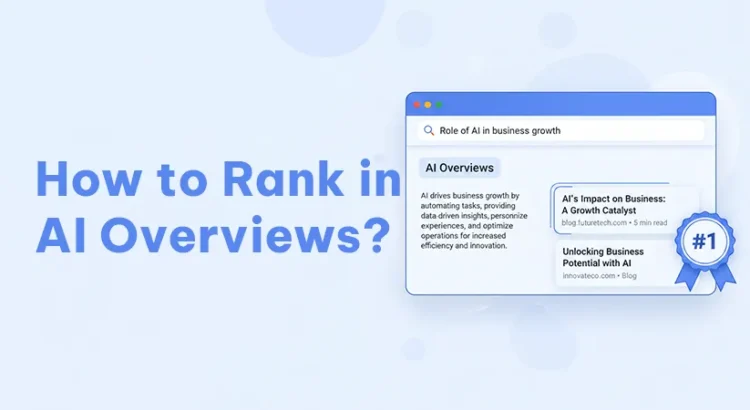
Business owners often ask how to rank in AI Overviews as search engines increasingly rely on artificial intelligence to summarize answers directly in search results. AI Overviews are changing how businesses appear in search by shifting visibility away from ten blue links toward concise, AI-generated explanations.
Instead of focusing only on rankings, businesses must now ensure their content can be clearly understood, trusted, and summarized by AI systems. This requires stronger content structure, clear topical coverage, and credible authority signals across the website. Technical quality, internal linking, and consistency also play a growing role in determining which sources are selected.
Many organizations turn to expert SEO services to adapt to this shift, as AI-driven search demands a different approach than traditional optimization. This guide explains how businesses can structure their websites, content, and authority signals to appear in AI Overviews consistently and remain visible in evolving search environments.
What Are AI Overviews?
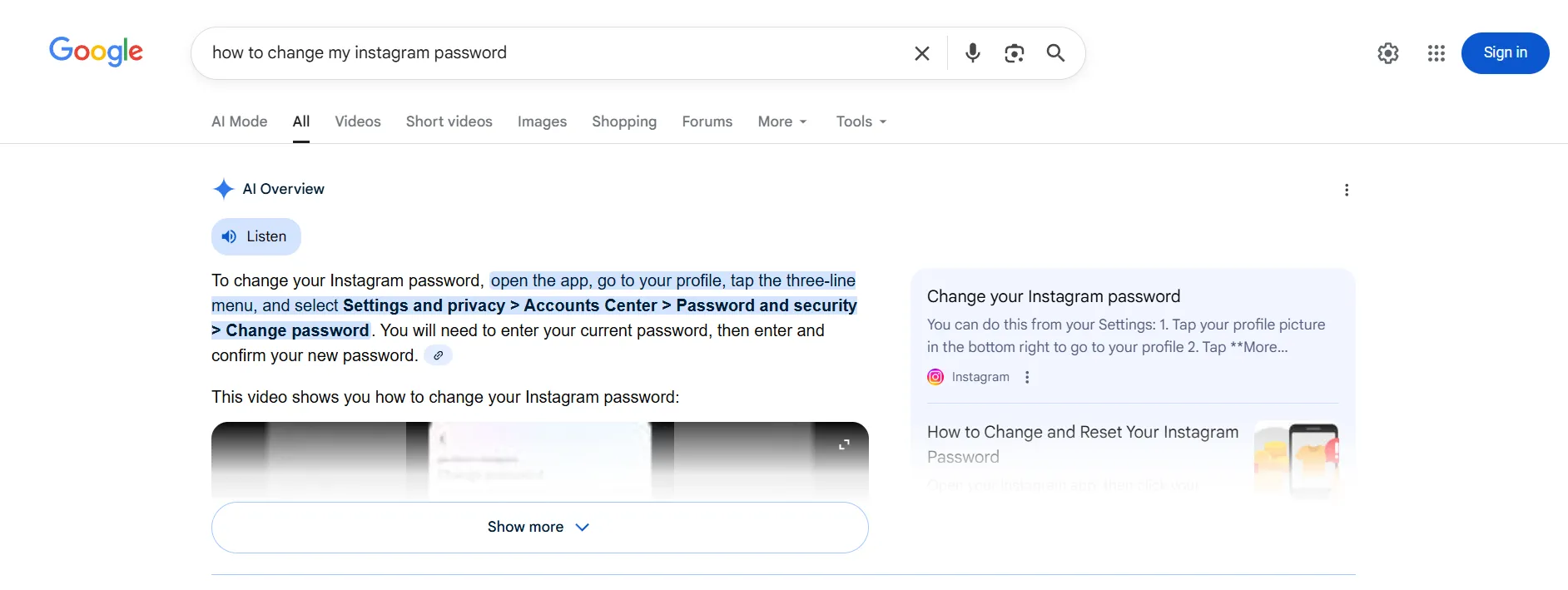
AI Overviews are AI-generated summaries that appear at the top of search results for many informational and decision-based queries. Instead of displaying only links, the search engine analyzes multiple trusted sources and produces a concise, synthesized answer directly on the results page.
Unlike traditional featured snippets that extract a single paragraph from one page, AI Overviews combine insights from multiple sources. They aim to give users a complete answer without requiring multiple clicks. This makes them highly influential for visibility, brand authority, and perceived expertise.
The key difference from traditional search results is intent fulfillment. Traditional rankings reward relevance and backlinks. AI Overviews reward clarity, structure, topical depth, and trustworthiness. Pages are chosen because they can be summarized accurately and confidently, not just because they rank well.
Why The AI Overviews Matter for Businesses
AI Overviews matter because they reshape how users discover, trust, and choose businesses. When an AI Overview references a business website, it implicitly signals authority and credibility. Users often treat AI-generated summaries as expert guidance rather than marketing content.
For businesses, this means reduced dependence on click-through rates alone. Even when users do not click, brand exposure increases. Over time, consistent inclusion builds recognition and trust at scale.
Ignoring AI Overviews risks invisibility. Many users now get answers without scrolling. If a business is not represented in these summaries, competitors who are included gain a disproportionate advantage in awareness, authority, and conversions further down the funnel.
Methods to Rank in AI Overviews for Business Websites
The methods to rank in AI Overviews for business websites are explained below. Each method focuses on how AI systems evaluate content, authority, and usability at scale.
1. Understand How AI Overviews Choose Sources
AI Overviews typically favor pages that are clear, direct, and structured for machine understanding. They prioritize content that demonstrates topical authority, trustworthiness, and usefulness beyond surface-level SEO.
If a page cannot be summarized cleanly in two to five sentences, it is unlikely to be selected. AI systems look for content that answers a specific question confidently without ambiguity. This means businesses must think less about keyword density and more about explanatory precision.
Pages that rely on vague language, filler content, or overly promotional messaging struggle because AI cannot extract a reliable answer from them. Clarity is the baseline requirement.
2. Answer-First Content Structure
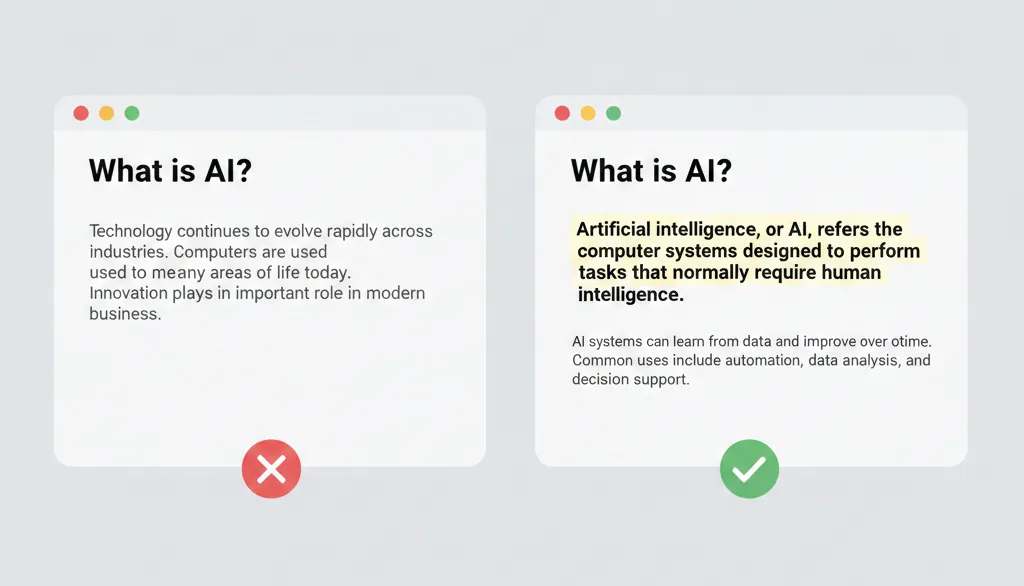
AI Overviews reward immediate answers. The most important information should appear at the top of the page, ideally within the first 40 to 60 words.
The structure should always follow this order. First, provide the direct answer. Second, expand with explanation, examples, or context. Third, add supporting details or related subtopics.
Long introductions, storytelling, or background history before answering reduce eligibility. AI systems scan quickly for direct responses. If the answer is buried, the page is often skipped.
Answer-first writing is not about oversimplification. It is about prioritizing clarity before depth.
3. Write For Questions, Not Just Keywords
AI Overviews are triggered mostly by question-based searches. Businesses should structure content around real questions users ask, not just short keywords.
Every important page should include explicit question-based headings. Each question should be answered immediately under the heading in a clear, factual manner.
This approach aligns perfectly with how AI extracts and summarizes information. When questions and answers are clearly paired, AI systems can confidently pull them into overviews without misinterpretation.
Over time, question-focused content builds a strong footprint across multiple AI-generated results.
4. Build Topical Authority, Not Single Pages
One page rarely ranks in AI Overviews on its own. AI prefers websites that demonstrate ownership of an entire topic, not isolated answers.
This is achieved through topic clusters. A pillar page covers a broad subject comprehensively. Supporting pages dive into specific subtopics in detail. Strong internal linking connects them logically.
When AI sees consistent, interconnected content around a topic, it interprets the site as a reliable authority. This dramatically increases selection frequency across related queries.
Topical authority compounds over time, making future content easier to surface.
5. Demonstrate Real Experience (E in E-E-A-T)
AI Overviews heavily favor experience-backed content. Theoretical explanations alone are no longer enough.
Businesses should include real-world examples, process breakdowns, and lessons learned. Describing mistakes, challenges, and improvements adds authenticity and depth.
Experience signals differentiate expert content from generic rewrites. AI models are trained to detect patterns of real operational knowledge versus surface-level summaries.
Showing how something is done in practice increases trust and selection likelihood.
6. Author And Brand Credibility Signals
AI systems evaluate who is behind the content, not just the content itself. Clear authorship and business identity are essential.
Every article should have a visible author name and bio that explains expertise. The website should include a detailed About page and a legitimate Contact page.
If a search engine cannot clearly understand who owns the content and why they are qualified, AI Overviews are less likely to reference it. Transparency builds machine trust.
7. Use Structured Formatting Everywhere
AI loves predictable, structured formats. Clean formatting improves readability for both users and machines.
Short paragraphs, clear subheadings, bullet points, and numbered steps all help AI parse information accurately. Consistency matters more than creativity.
Walls of text, complex layouts, or hidden content reduce extractability. AI prioritizes efficiency and clarity over design experimentation.
Structured formatting turns good content into usable content for AI.
8. Optimize For Summaries, Not Just Rankings
Businesses should actively design pages to be summarized. This means writing with extraction in mind.
Adding summary sections, key takeaways, or concise conclusions helps AI pull clean excerpts. Avoid vague language that requires interpretation.
Ask whether the page can be summarized accurately without losing meaning. If the answer is no, refinement is needed.
Summarization readiness is a major differentiator in AI Overview selection.
9. Schema Markup That Actually Helps AI
Schema markup improves clarity, not rankings. When used correctly, it helps AI understand content context.
High-impact schema types include Article, FAQPage, HowTo, Product, Organization, and LocalBusiness. FAQ and HowTo schema are especially useful for question-driven queries.
Schema should reflect visible content accurately. Overuse or misuse reduces trust. When aligned with content structure, schema improves interpretability.
10. Create Comparison and Decision Content
AI Overviews favor decision-support content. Comparisons, pros and cons, and use-case evaluations are frequently summarized.
These pages help users choose between options, making them ideal for AI extraction. Balanced, factual comparisons perform better than biased sales content.
Businesses that publish thoughtful decision content position themselves as advisors rather than advertisers.
11. Freshness and Updates Matter
AI prefers content that reflects current knowledge. Regular updates signal relevance and maintenance.
Core pages should be reviewed every three to six months. Adding new sections, clarifying outdated information, and updating dates helps maintain eligibility.
Stale content loses trust signals over time, even if it was once authoritative.
12. Build Brand Mentions Beyond Your Site
AI models learn from the broader web ecosystem. Brand mentions across platforms reinforce credibility.
Guest posts, podcasts, professional articles, and industry discussions all contribute. Backlinks help, but consistent brand presence matters more.
The goal is recognizability. When AI encounters the same brand across contexts, trust increases.
13. Optimize For Multiple AI Platforms
Google is not the only AI-driven interface. Bing Copilot, Perplexity, chat-based tools, and voice assistants all surface content differently.
Optimizing for these platforms requires neutral tone, clear definitions, and fact-based explanations. Overly sales-focused language reduces extractability.
Multi-platform optimization future-proofs visibility as AI search evolves.
14. Improve Site Quality Signals
AI Overviews avoid low-quality websites. Technical and UX fundamentals matter.
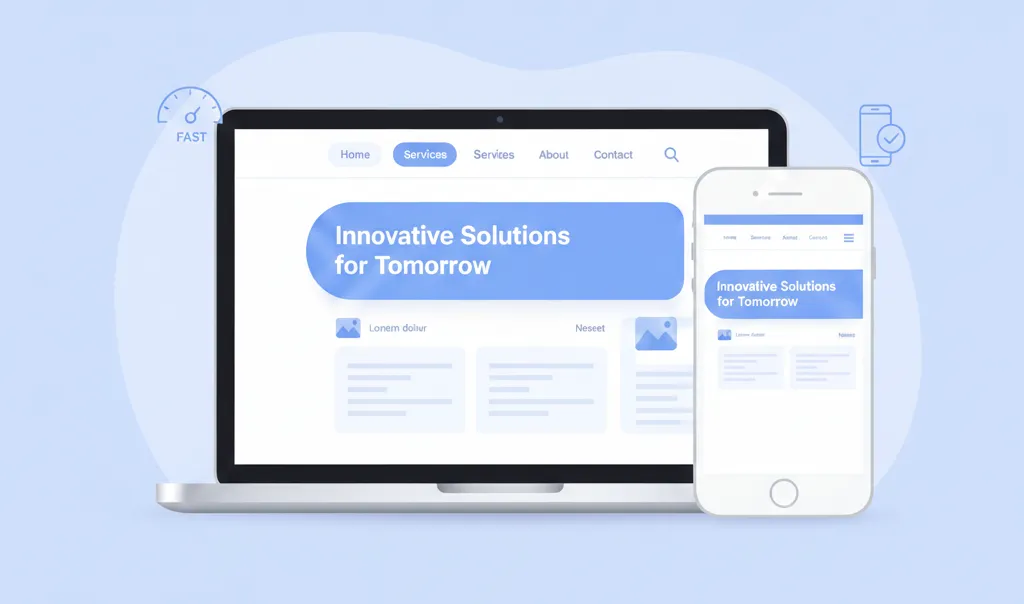
Fast loading speeds, mobile-friendly design, clean navigation, and minimal intrusive elements are baseline requirements. Keyword stuffing and spam signals lead to exclusion.
If a site feels untrustworthy to users, AI systems will treat it the same way.
15. Use Internal Links to Guide AI Context
Internal links help AI systems understand how your content is connected and which pages carry the most authority. When pages are linked logically, AI can map topic relationships and determine which pages act as primary references versus supporting explanations.
The best practice is to link from pillar pages to related cluster pages and ensure those cluster pages link back to the pillar. This creates a clear topical hierarchy that AI can follow. Anchor text should describe what the linked page is about using natural language.
Generic phrases like “click here” provide no context, while overly optimized anchors can look manipulative. Clean, descriptive internal linking strengthens topical authority and improves the likelihood that AI Overviews select your content as a reliable source.
16. Target Explainers, Not Just Commercial Pages
Purely commercial or sales-focused pages rarely appear in AI Overviews because they do not prioritize answering user questions. AI favors educational content that explains concepts, processes, and decision factors clearly.
Businesses should balance service or product pages with guides, explainers, checklists, tutorials, and strategy-focused articles. These informational pages establish topical authority and help AI understand your expertise across a subject area.
Over time, this authority flows into commercial pages through internal links and brand recognition. Explainer content acts as the foundation that supports visibility, while sales pages benefit indirectly from the trust those explanations build.
17. Write Like an Educator, Not A Marketer
AI Overviews consistently favor content written in an educational tone rather than a promotional one. Clear explanations, neutral language, and balanced viewpoints make it easier for AI to summarize information without bias.
Overly enthusiastic claims, exaggerated benefits, or unsupported statements reduce credibility and make content harder to extract accurately. Writing like an educator means focusing on helping the reader understand a topic fully, including limitations or trade-offs where relevant.
Sales messaging can still exist on conversion-focused pages, but informational content should prioritize teaching first. Trust is built through clarity, not persuasion.
18. Track AI Overview Visibility Manually
There is currently no reliable tool that fully tracks AI Overview visibility, so manual monitoring remains necessary. Businesses should regularly search their priority queries and observe which sources appear in AI Overviews.
Studying these results helps identify patterns in structure, tone, and depth that AI prefers. Reverse-engineering competitor content can reveal gaps or weaknesses in your own pages. Based on these insights, content should be refined, expanded, or restructured.
Manual tracking is time-consuming, but it provides real-world feedback that automated tools cannot yet match.
19. Be Consistent Across the Entire Site
AI does not evaluate pages in isolation. It assesses overall site quality, consistency, and clarity. A single high-quality page cannot compensate for weak or shallow content elsewhere.
AI looks at writing quality, topic coverage, internal alignment, and brand clarity across the entire website. Inconsistent tone, thin articles, or outdated pages can dilute authority signals and reduce trust.
Maintaining a consistent standard across all pages strengthens site-wide credibility and improves the chances that multiple pages are selected for AI Overviews.
20. Long-Term Mindset
AI Overviews reward authority built over time, not short-term optimization tactics. Sustainable visibility comes from publishing in depth, updating content regularly, and demonstrating real expertise through experience-based insights.
Building a recognizable brand presence across your site and the wider web reinforces trust signals that AI systems value. Results may not be immediate, but consistency compounds.
Businesses that commit to long-term content quality and authority development are far more likely to gain stable and recurring visibility in AI Overviews as search continues to evolve.
Conclusion: Key Takeaways on Optimizing for AI Overviews for Businesses
How to rank in AI Overviews ultimately comes down to clarity, authority, and consistency rather than short-term SEO tactics. Answer-first content improves extractability, topical authority establishes trust, and real experience strengthens credibility. Structured formatting makes content usable for AI, while ongoing updates keep it relevant.
Businesses that focus on education, transparency, and long-term value creation are best positioned to appear consistently in AI Overviews. AI visibility is not a one-time optimization but a sustained investment that compounds as authority grows.