

Generative engine optimization is becoming essential for businesses that want their content to be noticed and trusted in the age of AI-driven search. Unlike traditional SEO, which focuses on keywords, meta tags, and backlinks to climb search rankings, GEO is about making content a reliable source that AI systems can cite when providing answers.
The internet is moving away from the “Blue Links” model, where users clicked through long lists of results, toward a world where AI delivers concise, synthesized answers directly. In this evolving landscape, professional SEO experts guide businesses by combining traditional methods like content structuring and backlink strategies with new AI-focused techniques such as structured data, entity mapping, and citation optimization.
For businesses, embracing generative engine optimization means focusing not just on visibility but on credibility, ensuring content is accurate, well-structured, and positioned to be referenced by AI platforms.
What Is Generative Engine Optimization (GEO)?
Generative engine optimization, or GEO, is the practice of designing content and digital assets to be recognized and cited by AI-powered search engines, conversational agents, and LLM-driven platforms. While traditional SEO focuses on ranking web pages based on keyword relevance and backlink profiles, GEO emphasizes structured data, context, citations, and trustworthiness.
The GEO ecosystem includes advanced platforms such as Google Gemini, OpenAI SearchGPT, Perplexity AI, and other AI-driven answer engines. These systems employ generative retrieval, pulling knowledge directly from structured content, datasets, or live web sources, rather than solely relying on pre-indexed pages as in traditional index retrieval methods. Generative retrieval allows AI models to synthesize answers by combining multiple sources while giving proper attribution, which is why being recognized as a credible source is now critical.
By understanding this shift, brands can tailor content that not only ranks but is actively referenced in AI-generated answers, creating a direct line to user trust.

Why Is GEO Important?
Several forces make generative engine optimization increasingly crucial for businesses:
- Decline of Organic Click-Through Rates: Zero-click searches are on the rise, where users receive complete answers directly from AI or search snippets without visiting a website. Without GEO strategies, brands risk disappearing from the user’s awareness entirely.
- Shift to Conversational Queries: User behavior is evolving toward natural, conversational queries, such as “What is the most effective way to manage remote teams?” instead of short keyword phrases. GEO helps your content align with these long-tail conversational inputs.
- Business Risk of Exclusion: AI engines may omit your brand from synthesized answers if your content is not perceived as authoritative. Being “left out” can have tangible business consequences, as potential customers might rely solely on sources the AI cites, bypassing your website entirely.
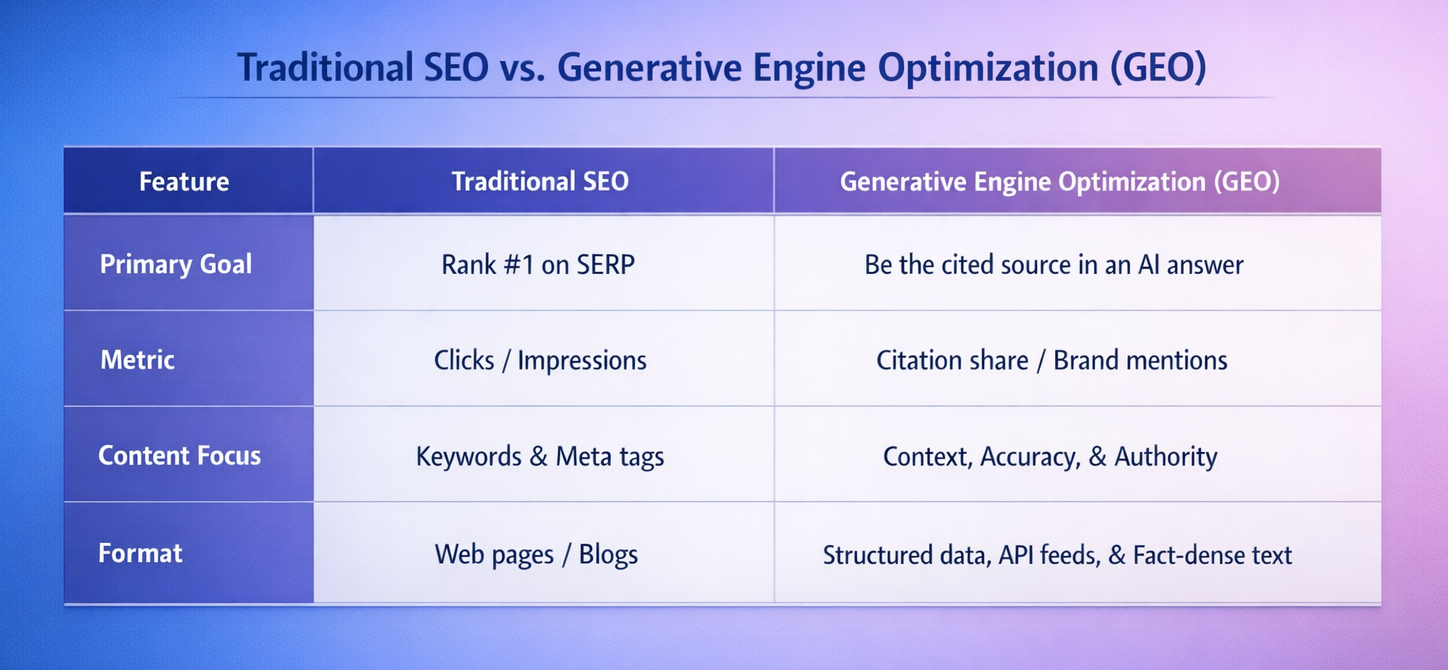
The shift from traditional SEO metrics like clicks and impressions to citation and authority-based measures underscores why GEO is becoming the defining strategy for digital visibility.
Generative Engine Optimization Strategies
Generative engine optimization strategies focus on why content gets selected, summarized, and cited by AI systems instead of simply ranking on a results page. AI engines look for clarity, accuracy, and trust when deciding which sources to include in their answers. This means businesses must think beyond keywords and start designing content that AI can easily understand, verify, and reuse. The strategies below explain the core concepts behind making content genuinely AI-friendly and suitable for generative platforms.
Optimizing for Citations and Footnotes
AI systems prefer information they can safely reference. To reduce the risk of incorrect answers, they lean toward sources that present clear, verifiable facts. Content should include fact-dense sentences that state one idea clearly, supported by data, definitions, or references. Avoid vague claims and long, opinion-heavy paragraphs. Instead, write precise statements such as definitions, statistics, timelines, or process explanations. Using headings, bullet points, and short paragraphs helps AI extract information more easily. When facts are easy to identify and validate, AI engines are more likely to cite your content as a reliable source.
Enhancing Content Depth (E-E-A-T 2.0)
Modern AI systems value experience as much as expertise. Simply repeating information already available online adds little value. Content should include real-world experience, such as practical examples, original case studies, lessons learned, or firsthand insights. This type of information is harder for AI to find elsewhere, which increases its importance. Instead of focusing only on keywords, show how ideas are applied in real situations. Deep, experience-based content signals credibility and helps AI engines recognize your site as a meaningful authority rather than just another summary page.
Data Density and “Quote-ability”
AI models prefer content they can summarize quickly and accurately. This makes short, factual sections extremely valuable. “Knowledge nuggets” are compact pieces of information that explain one idea clearly, such as a definition, comparison, or key takeaway. These sections should avoid filler words and focus on clarity. Statistics, concise explanations, and well-structured lists increase quote-ability. When content is easy to lift and reuse without losing meaning, AI systems are more likely to include it in their generated answers.
Sentiment and Reputation Management
AI engines often reflect overall public opinion when summarizing brands or topics. This means reputation across reviews, forums, social platforms, and discussion sites matters. Consistent positive sentiment helps AI present your brand accurately and favorably. Monitoring online discussions, responding to feedback, and correcting misinformation improves how AI systems interpret your brand. A strong, balanced online presence across multiple platforms helps ensure AI-generated summaries reflect trust, reliability, and expertise rather than isolated negative viewpoints.
Natural Language and Conversational Alignment
People interact with AI using full questions and natural language. Content should match this behavior. Instead of writing only short, keyword-focused phrases, structure content around real questions users ask, such as “How does generative engine optimization work?” or “What is the best way to structure content for AI search?” Writing in a conversational, clear tone improves understanding for both humans and AI. This alignment helps generative systems match your content directly to user intent and query context.

The “Source Diversity” Strategy
AI engines do not rely on websites alone. They gather information from videos, podcasts, expert discussions, interviews, and niche forums. Appearing across multiple formats strengthens your authority footprint. When a brand or expert is mentioned consistently on different platforms, AI systems gain stronger confidence in that source. This diversity signals credibility and reduces dependence on a single website. A broader presence increases the chances of being referenced in AI-generated responses.
Visual and Multi-Modal Optimization
We are entering the era of “Vision” models like GPT-4o and Gemini 1.5 Pro. These models don’t just read text; they “see” images, charts, and videos. To optimize for this, ensure your visual data is clean, labeled, and high-resolution. Charts should have clear legends and descriptive captions. When an AI scans a page to answer a complex data-related question, a well-optimized infographic can become the primary source for the AI’s synthesized response.
How Do You Perform Generative Engine Optimization?
Performing generative engine optimization requires a clear, hands-on approach focused on how AI systems understand, trust, and reuse information. Unlike traditional SEO checklists, GEO implementation is about testing perception, improving structure, and supplying AI engines with accurate, up-to-date knowledge. The steps below outline practical actions businesses can take to make their content more visible and reliable for generative platforms.
Conduct a “Brand Hallucination” Audit
A brand hallucination audit helps you understand how AI models currently describe your business. This can be done by using system prompts in different LLMs and asking direct questions about your brand, products, or services. The goal is to identify inaccurate descriptions, missing information, or outdated details. When errors appear, trace where the model may be sourcing that information from. Once gaps or inaccuracies are identified, publish clear, authoritative content to correct them. Over time, this improves how AI systems recognize and describe your brand.
Implementing Advanced Schema and Structured Data
Structured data gives AI engines clear signals about meaning and relationships. Using JSON-LD allows you to define how products, authors, services, and data points connect to each other. This goes beyond rich snippets. Proper schema helps AI understand who created the content, what it applies to, and how different elements relate. Clear structure reduces ambiguity and increases the chance of being referenced accurately in AI-generated answers.
Creating Proprietary “Information Gaps”
AI engines actively look for information that is new and original. Conducting surveys, publishing original research, or running technical experiments creates data that does not exist elsewhere. This type of content is especially valuable because AI systems cannot rely on older training data to replace it. When your site becomes a source of fresh insights, generative platforms are more likely to surface and cite your content when answering related questions.
Entity-Based Content Mapping
Entity-based content mapping replaces keyword lists with concept ownership. Start by identifying the main entities your brand should be known for, such as specific technologies, services, or problem areas. Then create content that explains these entities in depth and shows how they connect to related topics. Internal linking between these pieces helps AI understand topical authority. This structured network of ideas strengthens relevance far more effectively than isolated keyword-focused pages.
Optimizing for “Contextual Backlinking”
Backlinks still matter, but context now carries more weight than volume. The text around a link helps AI understand why your content is being referenced. When earning links, ensure the surrounding content clearly explains your expertise or contribution. Contextual mentions on relevant sites, articles, or discussions give AI systems stronger signals about authority and subject relevance than generic links alone.
Utilizing LLM-Friendly Formatting
Formatting directly affects how AI processes content. Clear headings, bullet points, numbered lists, and tables allow LLMs to scan and extract information efficiently. Markdown-style formatting works especially well for definitions, comparisons, and step-by-step explanations. Avoid large blocks of unstructured text. Well-organized content improves accuracy when AI systems summarize or quote your material.
Periodic Content Refreshing for “Live” Context
Many generative engines now access live web data. This makes content freshness critical. Regularly review and update statistics, examples, and references, especially for fast-changing topics. Clearly reflect updates within the content so AI systems recognize the latest version as authoritative. Keeping key pages current helps prevent outdated or incorrect information from appearing in AI-generated responses.
GEO vs. SEO
GEO and SEO both focus on improving online visibility, but they work in very different ways. Traditional SEO is designed to help web pages rank higher on search engine results pages so users click through to a website. Generative engine optimization, on the other hand, focuses on making content trustworthy and clear enough for AI systems to reference directly when generating answers. Instead of competing for rankings, GEO aims to become a reliable source within AI responses. This shift reflects how search is moving away from page-based results toward AI-driven summaries built on authority, accuracy, and context.
The Challenges and Ethics of GEO
Generative engine optimization introduces new challenges that did not exist in traditional SEO. One major issue is the black box problem. AI models do not clearly explain why certain sources are cited while others are ignored, which makes it difficult to measure performance or improve visibility with certainty. Another challenge is AI hallucinations, where models may incorrectly attribute facts or mix sources, even when content is accurate.
This requires ongoing monitoring to correct misinformation and reinforce authoritative signals. There is also the challenge of balancing AI optimization with human value. Content designed only for machines can feel unnatural or unhelpful to readers. Ethical GEO avoids manipulation and focuses on clarity, accuracy, and long-term trust, ensuring content remains genuinely useful for people while being understandable for AI systems.
The Future of Search Rankings
Search is moving toward a future shaped by personal AI agents that answer questions based on individual preferences, past behavior, and real-time context. In this environment, traditional SEO tactics may lose influence as AI-generated responses replace standard search result pages.
Visibility will depend less on rankings and more on whether an AI system trusts and references a source. GEO strategies will determine which brands are cited and which are ignored. To remain relevant, businesses must focus on structured content, clear expertise, and reliable information. Search visibility is shifting from earning clicks to earning trust within AI-generated answers.
Closing Notes on Generative Engine Optimization
Generative engine optimization marks a clear shift from page-based rankings to AI-driven knowledge systems. Success depends on three core pillars: authority, structure, and citations. Authority comes from expertise and real-world experience. Structure ensures content is easy for AI systems to understand and reuse. Citations confirm accuracy and reliability. GEO is not about chasing traffic alone; it is about becoming a dependable source within an AI’s knowledge framework. Brands that adapt to this approach will influence how information is discovered, summarized, and trusted in an AI-first digital landscape.