


Staying visible online depends on how well a website adapts to Google algorithm updates, which continually refine how search results are ranked. These changes aim to deliver better user experiences and more relevant information, but they can also disrupt traffic and rankings for unprepared sites. This guide explains how Google’s updates have evolved, why they matter, and what businesses can do to build lasting visibility in search.
What Are Google Algorithm Updates?
Google algorithm updates are changes made to the systems and formulas that determine how web pages are indexed and ranked in search results. These adjustments range from small, routine tweaks that improve efficiency to large-scale updates that can shift rankings across entire industries.
Each update refines how Google interprets website quality, relevance, and user experience. Some focus on content depth and originality, while others target technical performance, link practices, or how well a site satisfies user intent. While most updates are subtle and go unnoticed, major rollouts can lead to significant visibility gains or losses for businesses.
For site owners, understanding these updates is essential. They reveal what Google values in content and technical performance, guiding the improvements needed to maintain or grow rankings over time. To stay ahead of frequent changes, businesses rely on top SEO experts who specialize in monitoring updates and aligning websites with Google’s evolving standards.
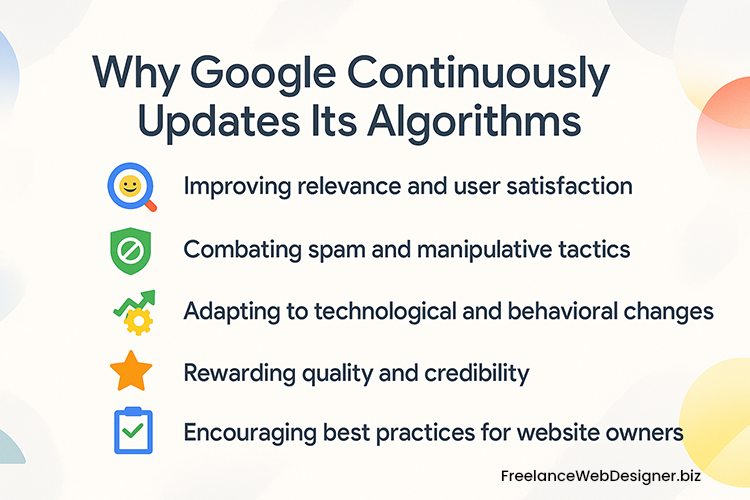
Why Google Continuously Updates Its Algorithms
Google refines its search algorithms on a constant basis to ensure that results remain accurate, useful, and aligned with changing user expectations. The way people search and consume information is not static, and without regular updates, the quality of results would quickly decline. These changes serve multiple purposes:
1. Improving relevance and user satisfaction
Every update aims to help users find content that truly matches their intent, whether they are looking for quick answers, in-depth research, or products to buy. Refinements reduce the chances of users landing on outdated, irrelevant, or poorly written pages.
2. Combating spam and manipulative tactics
Over time, some site owners develop shortcuts to exploit ranking systems, such as keyword stuffing, cloaked redirects, or mass link schemes. Updates like Penguin and Spam updates specifically target these practices, keeping search results free from manipulation.
3. Adapting to technological and behavioral changes
Search behavior evolves as new devices and technologies emerge. The rise of smartphones led to mobile-first indexing, while voice assistants and conversational AI made natural language processing essential. Google’s algorithms must evolve to interpret these new forms of interaction effectively.
4. Rewarding quality and credibility
Updates help elevate sites that demonstrate trust, expertise, and authority. Changes such as the Helpful Content update and E-E-A-T emphasis encourage publishers to provide content with real-world value rather than pages created solely for rankings.
5. Encouraging best practices for website owners
Algorithm changes are not only about filtering results but also about guiding site owners. By rewarding fast, user-friendly, and well-structured websites, Google nudges the entire web toward a better experience for visitors.
Through these continuous refinements, Google ensures its search engine remains relevant and dependable for billions of users. For businesses and website owners, understanding these motivations is critical for aligning strategies with Google’s long-term goals.
The Imperative of Staying Informed for SEO Success
Monitoring Google algorithm updates is essential for anyone who depends on organic search traffic. Each change can significantly influence how websites are ranked, sometimes within a short period, and businesses that fail to keep track often experience a drop in visibility and revenue.
Staying informed helps site owners make timely decisions that align with Google’s priorities rather than reacting only after traffic declines. There are several reasons why staying updated is critical:
1. Recognizing ranking fluctuations quickly
Understanding when an update has rolled out helps businesses determine whether a sudden drop or increase in traffic is due to Google’s systems or unrelated factors like technical issues or market trends.
2. Making proactive improvements
Awareness of what each update targets allows businesses to optimize their websites ahead of time, whether that involves improving page speed, enhancing content depth, or refining link practices.
3. Focusing on sustainable practices
Tracking the patterns in updates highlights which elements Google consistently values, such as unique content, trustworthiness, and user experience, while discouraging risky tactics like thin pages or excessive automation.
4. Maintaining a competitive edge
Businesses that adjust early often secure higher rankings while competitors lag behind. Regularly following algorithm news ensures a site does not lose ground in fast changing search results.
Staying informed is not simply about protecting rankings from penalties. It is also about building a foundation for consistent growth and ensuring a website remains relevant as Google’s systems evolve over time.
The Grand Evolution: A Historical Timeline of Google Search Algorithms
Google’s approach to ranking web pages has changed dramatically since its early days. What started as a system focused on links and keywords has grown into a complex network of signals powered by artificial intelligence, machine learning, and real user experience data.
Understanding how these updates unfolded over time helps businesses see why search optimization today goes far beyond keyword placement and link building.
Early Algorithms and Foundational Principles
In the early 2000s, Google’s ranking primarily relied on PageRank, a system that valued the number and quality of inbound links. The more sites pointed to a URL, especially high‑authority sites, the more important it seemed. Content relevance was largely tied to keyword matching in the page’s title, headings, and body text.
Over time, Google introduced refinements:
- Query refinement: Stop‑words, phrase matching, and improved stemming.
- Local and personalized results: Using user location and prior search history.
- Basic spam detection: Identifying obvious keyword stuffing and link buying.
These foundational principles—one page = one score, keyword relevance + link authority—were powerful but limited, especially as the web grew and SEO tactics evolved.
Key Milestones: From Foundational Shifts to AI Integration
Below is a chronological overview of landmark updates that marked the shift from simple relevance metrics to AI‑powered evaluation:
- 2011 – Panda Update: Introduced content quality as a core factor—targeting thin, duplicate, and low‑value pages.
- 2012–2014 – Penguin Update: Targeted unnatural or manipulative link profiles, penalizing spammy backlinks.
- 2013 – Hummingbird: Rewrote Google’s core ranking logic to support semantic search and conversational queries.
- 2015 – RankBrain: A machine learning layer supplementing Hummingbird, helping interpret ambiguous queries.
- 2016+ – Mobile‑First Indexing: Began indexing mobile versions of pages first, reflecting mobile dominance.
- 2019 – BERT: Enabled Google to better understand the nuance and context of natural language search queries.
- 2020+ – Core Web Vitals: Introduced real‑world user experience metrics like page load speed and stability.
- 2021–2024 – Product Reviews, Helpful Content, Spam Updates, Site Reputation Abuse: Focused on content usefulness, trust, and combating scaled abuse.
- 2023–2025 – E‑E‑A‑T & Content Guidelines for AI‑Generated Content: Emphasis on demonstrable real‑world expertise and caution around AI‑assisted writing.
For a detailed chronological look at these major changes, see The Evolution of Google Search: A Timeline of Major Algorithm Changes.
The Ongoing Shift Towards User Experience and Advanced AI
In recent years, the trend has clearly shifted toward evaluating user experience, intent alignment, and content credibility—driven by AI and machine learning. Google’s ranking evolution now reflects:
- Real‑world usage metrics (Core Web Vitals).
- Semantically rich content that matches user intent rather than keyword‑matching.
- Trust signals like author credentials, product review depth, transparency.
- Adaptive algorithms that learn continually from user interactions.
The net result: SEO is no longer about gaming systems, but delivering exceptional, trustworthy, contextually relevant experiences.
Deep Dive: Understanding Core Algorithm Updates & Their Specific Impacts
Google’s most significant algorithm updates have shaped the standards for content quality, technical performance, and overall user experience. Each update targeted specific issues, guiding businesses to build websites that are more relevant, trustworthy, and user-friendly.
Google Panda Update: The Dawn of Content Quality
Launched in 2011, the Panda update marked a turning point by prioritizing content quality as a central ranking factor. Its goal was to reduce the visibility of sites that relied on thin content, duplicate pages, or content farms producing low-value articles at scale. Websites with keyword-stuffed, shallow, or scraped content saw dramatic ranking drops, while those offering unique and informative material benefited.
The update emphasized the need for original, in-depth, and well-structured information that serves the user’s intent. Businesses learned that volume alone could not secure rankings; substance and relevance became the foundation of visibility. To explore this in more detail, see Google Panda Update: Understanding Content Quality & Duplicate Content Impact.
Google Penguin Update: Reining in Link Spam
Introduced in 2012, Penguin focused on the growing problem of manipulative link practices. Many websites had relied on buying backlinks, participating in link networks, or creating excessive low-quality links to boost authority artificially. Penguin penalized these tactics, reducing the rankings of sites with unnatural link profiles.
The update encouraged website owners to focus on earning links organically through valuable content, reputable partnerships, and ethical outreach. Cleaning up spammy links and building trust-based connections became essential for recovering from Penguin penalties. For a deeper look at how this update reshaped link-building practices, see Google Penguin Update: Navigating Link Spam & Building a Healthy Backlink Profile.
Google Hummingbird and RankBrain: The Rise of Semantic Search and AI
Hummingbird, launched in 2013, overhauled Google’s core search engine logic to better understand the meaning behind queries rather than simply matching keywords. It supported conversational searches and recognized synonyms and context, paving the way for more natural results.
In 2015, RankBrain added a machine learning layer that helped Google interpret ambiguous or complex searches. Together, these systems allowed Google to match results with user intent, even when exact keyword matches were absent, shifting SEO toward semantic content creation.
Learn more in our detailed article Google Hummingbird & RankBrain: Understanding Semantic Search & AI in SEO.
Mobile-First Indexing: Google’s Mobile-Centric World
With the rapid growth of smartphone usage, Google introduced mobile-first indexing in 2016, eventually making mobile versions of websites the primary source for indexing and ranking. Websites that were not mobile-friendly faced lower visibility, as mobile usability became central to the user experience.
Responsive design, fast loading times, and seamless navigation on smaller screens became critical elements for maintaining rankings. Sites optimized for desktop alone quickly fell behind as mobile use surpassed traditional browsing. To learn more about adapting your site for this shift, read Mobile-First Indexing: Adapting Your Website for Google’s Mobile-Centric Approach.
BERT Update: Understanding Nuance and Context
Released in 2019, BERT (Bidirectional Encoder Representations from Transformers) enhanced Google’s understanding of natural language, especially in complex, conversational, or long-tail queries. BERT enabled Google to grasp the relationships between words in a sentence, improving the relevance of search results for nuanced queries.
For website owners, this meant that clear, natural language writing became even more important. Content written for humans, not just search engines, was more likely to perform well. To explore this update in detail, see BERT Update: How Google Understands Context & Natural Language in Search.
Core Web Vitals: Measuring Real-World User Experience
Core Web Vitals, introduced as part of Google’s ranking criteria in 2020, measured specific aspects of user experience. These included loading performance (Largest Contentful Paint or LCP), interactivity (First Input Delay or FID), and visual stability (Cumulative Layout Shift or CLS).
Websites that loaded quickly, responded smoothly to interactions, and provided a stable visual layout earned a boost in rankings. Businesses had to invest in performance optimization, such as faster hosting, efficient coding, and improved site design, to meet these standards.
To learn more about how these metrics work and their impact on search rankings, read Core Web Vitals Explained: User Experience Metrics for Google Rankings.
Product Reviews Updates: Rewarding Authentic E-commerce Insights
Starting in 2021, Google rolled out a series of updates focused on product review content. These changes rewarded in-depth, expert-driven reviews that offered first-hand experience, detailed analysis, and trustworthy recommendations.
Sites relying on generic, templated reviews without meaningful insights saw a decline, while those offering rich media, original research, and author transparency gained visibility. This shift pushed e-commerce and affiliate websites to elevate their review content beyond surface-level descriptions.
To learn more about creating high-quality, trustworthy review content, see Product Reviews Updates: Building Trust with Authentic E-commerce Content.
Helpful Content Update: Prioritizing People-First Content
Launched in 2022, the Helpful Content update aimed to reduce the influence of content created primarily to attract search traffic without serving users. It targeted sites producing mass amounts of low-value content designed to rank, such as articles written for keywords without providing substantial value.
Websites that focused on originality, depth, and satisfying user intent gained higher rankings, while those relying on search-first content strategies lost traction. The update reinforced the importance of writing for readers, not just algorithms.
Learn more about creating content that truly serves users in Helpful Content Update: Creating Content That Truly Serves Users.
E-E-A-T (Experience, Expertise, Authoritativeness, Trustworthiness): The Pillars of Credibility
Although not a single update, Google’s focus on E-E-A-T became a defining factor in evaluating website quality between 2023 and 2025. Sites demonstrating the author’s real-world experience, professional expertise, recognized authority, and trustworthiness earned stronger rankings.
This framework encouraged businesses to highlight credentials, cite reliable sources, maintain transparency, and ensure content accuracy. For industries like health, finance, and e-commerce, these signals became essential for maintaining visibility.
For a comprehensive guide on how to implement these principles and build credibility for your website, read E-E-A-T (Experience, Expertise, Authoritativeness, Trustworthiness): Building Credibility for SEO.
Google Spam Updates (General): The Ongoing War on Web Spam
Google continues to roll out periodic spam updates aimed at eliminating unethical SEO practices. These target automatically generated content, manipulative redirects, cloaking, and other tactics designed to deceive search engines.
By rewarding sites that follow ethical practices and removing those that exploit loopholes, these updates preserve the quality and reliability of search results. For a detailed guide on how to combat spam and maintain ethical SEO, see Google Spam Updates: Combating Spam & Maintaining Ethical SEO Practices.
Site Reputation Abuse Update: Addressing Scaled Third-Party Spam
Introduced in 2024, this update tackled the misuse of high-authority domains that allowed low-quality third-party content. Read Google’s official announcement for more details. Google reduced the visibility of such pages, ensuring that authority cannot be artificially leveraged for unrelated or spammy content.
Websites hosting user-generated or sponsored content had to implement stricter quality controls to maintain their rankings. For a detailed look at how this update works and strategies to protect your website, see Site Reputation Abuse Update: Combating Scaled Content Abuse & Third-Party Spam.
Google’s Stance on AI-Generated Content: Guidelines for AI in SEO
As AI-assisted writing tools became widespread, Google clarified its stance between 2023 and 2025. AI-generated content is not automatically penalized, but it must meet the same standards of quality, originality, and usefulness as human-written material. Content created solely to manipulate rankings or produced without oversight risks devaluation.
For businesses, this means AI can be a helpful tool, but human review and editorial oversight are crucial to ensure accuracy, originality, and alignment with user needs. For further insights on how AI impacts search and optimization practices, see Google’s Stance on AI-Generated Content: What Updates Mean for AI in SEO.
Proactive Strategies: Preparing Your Website for Future Updates
Google’s ranking systems continue to change, and websites that prepare in advance can avoid sudden traffic drops and even gain visibility when new updates roll out. The following strategies help build a resilient online presence.
Building a Robust Technical SEO Foundation
A strong technical base makes it easier for Google to understand and rank your website. To maintain this foundation:
- Ensure your site has a clear, crawlable structure with organized internal linking.
- Optimize title tags, meta descriptions, and header tags for clarity and relevance.
- Use clean, efficient code to improve page performance and reduce errors.
- Conduct regular technical audits to identify broken links, duplicate content, or indexing issues.
- Prioritize fast-loading pages through optimized images, caching, and reliable hosting.
Consistently Creating High-Quality, User-Centric Content
Search visibility depends on content that serves users, not just algorithms. Creating pages that are informative, engaging, and tailored to user intent is key to long-term success. Many businesses partner with teams offering expert digital marketing solutions to ensure their content strategy meets Google’s evolving standards and delivers real value to their audience. Focus on:
- Publishing original, in-depth, and informative pages that answer real user questions.
- Avoiding duplicate or thin content that adds little value.
- Updating older content to keep information current and accurate.
- Diversifying content formats, such as guides, videos, and visuals, to engage different audiences.
- Organizing pages logically so readers can easily find and understand the information.
Cultivating a Natural and Authoritative Backlink Profile
Backlinks remain important signals of trust and authority. Strengthen your link profile by:
- Earning links naturally through high-quality, shareable content.
- Building relationships with reputable websites in your industry for outreach opportunities.
- Avoiding paid link schemes, link farms, or excessive reciprocal linking.
- Regularly auditing your backlinks to identify and disavow harmful or spammy links.
- Creating content assets such as studies or tools that naturally attract organic references.
Prioritizing Excellent User Experience
User satisfaction influences engagement metrics and rankings. To improve overall experience:
- Design for mobile-first, ensuring all elements are responsive and easy to navigate.
- Optimize Core Web Vitals by improving loading speed, responsiveness, and visual stability.
- Minimize intrusive pop-ups or elements that disrupt the browsing experience.
- Streamline navigation so users can find information quickly.
- Test and refine user flows to reduce friction and keep visitors engaged longer.
Continuously Demonstrating E-E-A-T
Experience, Expertise, Authoritativeness, and Trustworthiness are key signals for credibility. To showcase these qualities:
- Highlight author bios and credentials for all expert-driven content.
- Cite reputable sources and include references to support factual claims.
- Keep all content accurate and regularly updated to maintain reliability.
- Maintain transparency through clear contact details, policies, and editorial standards.
- Build authority by earning mentions or features from well-known industry sources.
Reactive Measures: Diagnosing & Recovering from Algorithm Impacts
Even with careful preparation, websites can be affected by Google updates. Understanding how to identify, analyze, and address these impacts can help restore rankings and traffic over time.
Identifying the Signs of an Algorithm Hit
Before taking action, confirm that a drop in traffic or rankings is linked to an algorithm update:
- Monitor analytics and search console data for sudden traffic declines, especially within a few days of a known update.
- Compare affected pages or keywords to see if the drop is concentrated in specific areas (content type, device, or region).
- Check Google’s official update announcements or trusted industry sources for confirmation.
- Rule out technical errors, site outages, or seasonal fluctuations that could mimic algorithm effects.
Step-by-Step Diagnostic Process
Once an update is suspected, a structured review helps uncover the cause:
- Analyze the types of pages that lost visibility to identify patterns (thin content, outdated information, or slow performance).
- Review technical elements such as page speed, crawl errors, and mobile usability.
- Audit backlink profiles for unnatural or low-quality links that may have triggered a penalty.
- Compare your site’s content depth, accuracy, and authority to competitors that gained rankings.
- Identify which signals the update targeted (content quality, spam, user experience) and where your site falls short.
Developing a Strategic Recovery Plan
Recovery depends on aligning your website with the standards introduced by the update. Key actions include:
- Improving or consolidating low-quality or duplicate content into more comprehensive, valuable pages.
- Removing or disavowing spammy backlinks and focusing on ethical link-building efforts.
- Enhancing site speed, navigation, and mobile responsiveness to meet Core Web Vitals benchmarks.
- Adding author credentials, citations, and factual accuracy to boost trust signals.
- Continuing to publish original, user-focused content that fulfills search intent better than competitors.
The Importance of Patience and Persistence
Regaining lost visibility often takes time, as Google reassesses sites during future crawls and updates. To stay on track:
- Continue monitoring rankings and traffic for gradual improvements over several weeks or months.
- Avoid quick fixes like mass content deletion or aggressive link purchases, which can worsen problems.
- Focus on long-term improvements rather than chasing temporary gains.
- Stay informed about future updates to avoid repeat issues and to refine your site proactively.
For a more detailed guide on combining proactive preparation with post-update recovery, check out Preparing for & Recovering from Google Algorithm Updates: A Proactive & Reactive Guide.
Conclusion: Embracing the Dynamic Nature of SEO
Search optimization is not a fixed process but a constantly evolving effort shaped by Google algorithm updates. Websites that remain flexible and willing to adapt are the ones most likely to maintain and grow their visibility over time.
Google continues to refine its systems to serve users better, rewarding websites that offer trustworthy, valuable, and seamless experiences. Each update, whether large or small, reflects a shift toward a search landscape that prioritizes user intent, mobile usability, and content credibility.
Work with a Team That Understands the Algorithm Shifts
Navigating Google algorithm changes can be challenging without the right expertise. Our team of adaptive SEO professionals specializes in monitoring updates, auditing websites, and creating strategies that align with Google’s evolving standards. Whether your goal is to recover from a ranking drop or strengthen your long-term visibility, we can help you build a future-ready online presence. Get in touch with us to discuss your needs and take the next step toward sustainable growth.