

Enterprise SEO strategies are essential for organizations managing large websites that operate in highly competitive search environments. Unlike smaller sites, enterprise-level platforms deal with thousands or even millions of pages, complex technical infrastructures, and multiple decision-makers influencing every change.
Ranking such websites is not about quick fixes or isolated optimizations. It requires structured planning, scalable execution, and alignment with long-term business objectives. Enterprise SEO differs from traditional SEO because it must balance technical precision, content governance, and operational efficiency at scale.
Large organizations often rely on experienced enterprise SEO consultants during the planning phase to align search initiatives with broader marketing, product, and revenue goals. This guide explores what enterprise SEO involves, why it is critical, and how organizations can implement proven strategies to achieve sustainable growth rather than short-lived ranking gains.
What Is Enterprise SEO?
Enterprise SEO is a specialized approach to search engine optimization designed for large, complex websites with extensive page volumes and diverse audiences. It focuses on managing scale without sacrificing quality, accuracy, or consistency.
At its core, enterprise SEO emphasizes structured processes over manual actions. Automation plays a major role, as does the use of advanced analytics to guide decisions. Instead of optimizing individual pages in isolation, teams focus on templates, systems, and frameworks that influence thousands of URLs simultaneously.
This discipline is most relevant for global brands, ecommerce marketplaces, SaaS platforms, publishers, financial institutions, and any organization whose digital presence spans multiple regions, languages, or product categories.
These businesses typically operate with multiple stakeholders across marketing, development, product, and legal teams, making coordination a central challenge. Enterprise SEO bridges these functions by aligning technical and content decisions with measurable business outcomes.

Why Enterprise SEO Is Critical for Large-Scale Websites
For large organizations, organic search is one of the most reliable and cost-effective growth channels over time. Paid media can drive immediate traffic, but its impact stops when budgets are reduced. In contrast, a well-executed enterprise SEO program builds lasting visibility that compounds over months and years.
Strong organic performance directly influences revenue, brand credibility, and customer acquisition costs. High search visibility positions a brand as an authority, which improves trust even before a user visits the website. It also reduces dependence on paid channels, allowing marketing budgets to be allocated more efficiently.
Ignoring SEO at scale creates serious risks. Large sites can suffer from index bloat, where search engines crawl and index low-value pages that dilute overall quality signals. Technical debt can accumulate through outdated templates, inefficient scripts, or poor internal linking structures. Without a clear strategy, traffic volatility becomes common, and competitors with more disciplined search programs steadily capture market share.
Effective Enterprise SEO Strategies
Managing SEO for a large website requires a structured framework rather than a collection of disconnected tactics. The following strategies are built on proven best practices and are designed to work together, supporting scalability, consistency, and long-term performance. Each strategy addresses a critical component of large-scale optimization while aligning technical execution, content development, and organizational processes.
1. Establish Clear SEO Governance
Clear SEO governance ensures that optimization efforts remain consistent across large teams, departments, and regions. In enterprise environments, multiple stakeholders influence website changes, which can easily lead to fragmented implementation if rules are unclear.
Governance defines who owns SEO decisions, how standards are documented, and how updates are approved. It also ensures that SEO considerations are embedded into content publishing, development cycles, and redesigns. With proper governance, large organizations avoid conflicting practices, maintain quality across thousands of pages, and reduce the risk of unintentional performance losses caused by uncoordinated changes.
2. Build a Scalable Technical Foundation
A scalable technical foundation allows large websites to grow without creating performance bottlenecks or crawl inefficiencies. This includes clean code, fast-loading templates, logical URL structures, and reliable hosting infrastructure. At enterprise scale, technical weaknesses multiply rapidly, affecting thousands of pages at once.
A strong foundation ensures search engines can consistently access, render, and understand content regardless of site size. Ongoing technical monitoring and regular audits help identify emerging issues early, preventing them from turning into widespread visibility problems that are costly to reverse later.
3. Optimize Crawl Budget and Indexation
Large websites must actively guide search engines toward their most valuable pages. Without control, crawlers may spend resources indexing duplicate, low-value, or outdated URLs. Crawl budget optimization focuses on signaling which pages deserve attention and which should be excluded.
This involves managing canonicalization, robots directives, pagination, and internal linking depth. When done correctly, search engines spend more time on revenue-driving and authoritative content. Over time, this improves index quality, stabilizes rankings, and prevents dilution caused by unnecessary or redundant URLs.
4. Design an Intelligent Site Architecture
Site architecture determines how content is grouped, connected, and discovered. For enterprise websites, architecture must support both usability and search engine understanding. A well-designed hierarchy groups related topics logically and ensures important sections are no more than a few clicks from the homepage.
This structure distributes authority effectively while helping users navigate complex catalogs or content libraries. Intelligent architecture also simplifies future expansion, allowing new categories or regions to be added without disrupting existing performance or creating structural confusion.

5. Implement Template-Based On-Page Optimization
Template-based optimization allows enterprises to apply on-page best practices consistently across thousands of URLs. Instead of manually optimizing each page, templates control titles, headings, metadata, structured data, and content placement dynamically. This approach ensures uniform quality while allowing contextual variation where needed.
Templates must be carefully designed to avoid duplication and keyword stuffing. When implemented correctly, they improve efficiency, reduce human error, and make large-scale optimization manageable without sacrificing relevance or clarity for users and search engines.
6. Develop a Data-Driven Keyword Framework
Enterprise keyword strategy requires structure rather than isolated research. A data-driven framework organizes keywords by intent, topic, and business value, ensuring content coverage without overlap. This framework helps teams prioritize opportunities based on impact rather than raw search volume alone.
It also supports collaboration across departments by clearly defining which pages target which queries. Over time, a structured keyword framework prevents internal competition, improves topical authority, and allows organizations to scale content creation strategically instead of reactively.
7. Align Content Strategy with Search Intent
Search intent alignment ensures that content meets user expectations at every stage of the journey. Enterprise websites often publish large volumes of content, but without intent alignment, much of it fails to rank or convert. This strategy focuses on matching page formats, depth, and messaging with informational, commercial, or transactional intent.
Clear intent mapping improves engagement, reduces bounce rates, and strengthens trust signals. At scale, intent-driven content planning helps enterprises maximize returns from both existing and newly created pages.
8. Strengthen Internal Linking Systems
Internal linking connects content across a large website, guiding users and search engines toward priority pages. At enterprise scale, internal links influence crawl paths, authority distribution, and topical relevance. A structured internal linking system ensures that important pages receive consistent support from related sections.
Automated linking can help, but it must be carefully controlled to maintain relevance. Strong internal linking improves discoverability of deep pages and reinforces the overall semantic structure of the site without relying solely on external links.
9. Manage Duplicate and Thin Content
Duplicate and thin content are common challenges for large websites due to filters, faceted navigation, and automated page creation. Left unchecked, these issues dilute quality signals and waste crawl resources. Managing them requires both technical controls and editorial oversight.
Consolidation, canonicalization, and content enrichment help ensure that indexed pages provide real value. By focusing on quality over quantity, enterprises protect their authority and prevent search engines from misinterpreting site scale as low relevance.
10. Leverage Automation and SEO Tools
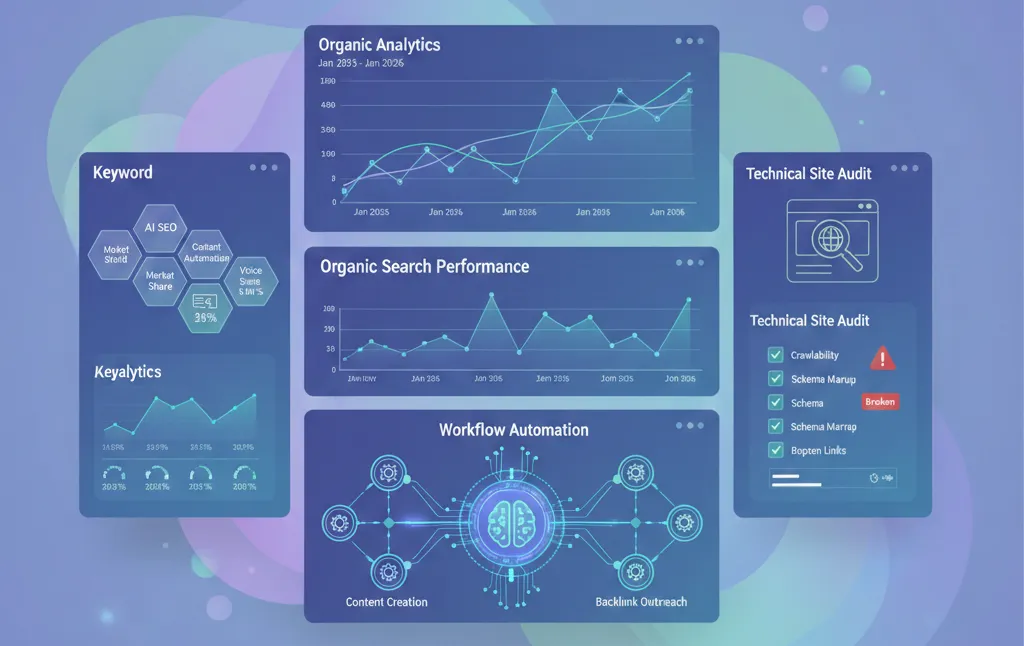
Automation enables enterprise teams to monitor, analyze, and act at scale. SEO tools help track rankings, identify technical issues, and measure content performance across large datasets. Automation reduces manual workload while improving consistency and response time.
However, tools should support strategic decisions rather than replace them. When used correctly, automation allows teams to focus on planning and optimization instead of repetitive tasks, making large-scale SEO operations more efficient and sustainable.
11. Integrate SEO Into Development Workflows
SEO integration into development workflows prevents costly rework and delays. When optimization is considered during planning and design stages, technical best practices are implemented by default. This includes URL handling, page speed considerations, and structured data support.
Integrating SEO checkpoints into agile workflows ensures that new features and updates enhance visibility rather than introduce issues. Over time, this approach reduces technical debt and creates a smoother collaboration between marketing and development teams.
12. Coordinate Across Teams and Regions
Enterprise websites often operate across multiple markets, languages, and departments. Coordination ensures that standards are maintained while allowing flexibility for local needs. Clear communication channels, shared documentation, and regular alignment meetings help prevent fragmentation.
Central teams provide guidance, while regional teams adapt strategies to local search behavior. Effective coordination ensures consistent quality, faster execution, and stronger overall performance across global digital properties.
13. Measure Performance with Meaningful Metrics
Measuring success at the enterprise level requires more than tracking rankings. Meaningful metrics connect SEO performance to business outcomes such as qualified traffic, conversions, and revenue impact. Clear reporting frameworks help stakeholders understand progress and justify investment.
Consistent measurement also identifies underperforming areas and emerging opportunities. By focusing on actionable metrics, organizations ensure that optimization efforts remain aligned with broader business goals rather than isolated SEO indicators.
14. Adapt to Algorithm Changes Proactively
Search engine algorithms evolve continuously, and large websites must adapt without disruption. Proactive adaptation involves monitoring industry signals, analyzing performance trends, and testing changes in controlled environments.
Instead of reacting after traffic drops, enterprises adjust strategies gradually based on data. This reduces risk and helps maintain stability during updates. A proactive mindset allows organizations to stay competitive while protecting long-term visibility across large and complex sites.
15. Commit to Continuous Improvement
Enterprise SEO is an ongoing process rather than a fixed project. As websites expand and markets evolve, new challenges emerge. Continuous improvement involves regular audits, performance reviews, and strategic refinement.
Testing new approaches, learning from results, and iterating systems ensure long-term effectiveness. Organizations that commit to steady improvement build resilient SEO programs that adapt over time, supporting sustained growth even as competition and algorithms change.
Key Challenges in Enterprise SEO
Large organizations face unique obstacles that make optimization more complex than it appears. The sheer size of websites introduces technical challenges that are difficult to diagnose and resolve quickly. Implementation cycles are often slow due to multiple approval layers and competing priorities.
Legacy systems can limit flexibility, while cross-team dependencies make coordination difficult. Maintaining consistency across regions, languages, and departments requires constant communication and strong governance. Without clear processes, even well-planned initiatives lose momentum, leading to fragmented execution and missed opportunities.
Summary of Enterprise SEO Strategies
Enterprise SEO strategies provide a practical checklist for large-scale websites competing in crowded search landscapes. Success depends on building scalable systems, aligning teams around shared objectives, and committing to continuous improvement instead of isolated actions.
Organizations that invest in structured processes, data-driven decisions, and long-term planning are better positioned to manage complexity and maintain visibility as they grow. By focusing on sustainable practices and cross-functional alignment, large websites can turn search into a dependable growth engine that delivers lasting value.