


Analyzing the rapid shift in consumer behavior reveals that ecommerce business trends in 2026 represent a fundamental departure from the static shopping carts of the past decade. The digital marketplace has evolved into a highly intuitive, sentient ecosystem where the line between virtual and physical reality is almost non-existent. This transformation in online retail closely aligns with broader shifts in the digital landscape, as discussed in Digital Marketing Trends: The Future of Online Promotion.
For brands looking to survive, the focus has shifted from mere transactional efficiency to the creation of deeply immersive, value-driven experiences. Achieving this level of sophistication requires a deep partnership with expert ecommerce developers who can bridge the gap between complex backend architectures and seamless frontend interactions.
Success in this climate is no longer about chasing every novelty; it is about recognizing the structural shifts that are redefining how value is exchanged and how trust is built with a more discerning, tech-savvy global audience. By moving beyond outdated methodologies and embracing a more holistic, consumer-centric approach, businesses can secure their position in an increasingly competitive and automated landscape.
Crucial Ecommerce Business Trends in 2026
The evolution of digital trade has reached a point where innovation is driven by a necessity for speed, radical transparency, and extreme personalization. As we move deeper into this decade, the underlying infrastructure of online retail is being rewritten to accommodate a world where machines are just as likely to be the customers as humans. Understanding these ecommerce business trends is vital for any enterprise aiming to remain relevant in a market defined by instant gratification and algorithmic precision.
1. Agentic Commerce (AI “Personal Shoppers”)
The most significant change in the way products are discovered and purchased is the rise of autonomous shopping agents. These are not just advanced chatbots designed to answer basic questions; they are sophisticated digital assistants capable of making independent decisions based on a user’s specific goals and historical data.

The Shift to Autonomous Decision-Making
In the current marketplace, the burden of search rests on the consumer. Individuals spend hours browsing categories, reading contradictory reviews, and comparing prices across different browser tabs. The agentic model flips this paradigm. A customer simply provides a high-level intent, and the AI agent scours the entire web to find the most sustainable, cost-effective, or high-quality option available. This means that instead of optimizing for human eyeballs, brands must now optimize their product data for “machine readability.”
Machine-Readable Data Optimization
To capture the attention of these digital shoppers, product information must be more structured and transparent than ever before. If an AI agent cannot verify the material origin, shipping timeline, or return policy of an item within milliseconds, that product will simply be omitted from the shortlist. Businesses are now investing heavily in structured schema and API-first product catalogs to ensure they are visible to the autonomous assistants that are beginning to dominate the decision-making funnel.
2. Hyper-Personalization 2.0
Personalization has moved far beyond using a customer’s first name in an email. We have entered the era of the Dynamic User Experience (UX), where the entire storefront is a fluid entity that reshapes itself for every individual visitor.
Real-Time Interface Adaptation
Imagine a website that recognizes the browsing habits of a user in real-time. If a shopper is moving quickly and focusing on technical specifications, the interface automatically simplifies, highlighting bullet points and shipping speeds. Conversely, if a shopper is browsing leisurely, the site might transition into a more editorial, visual-heavy layout with storytelling elements and lifestyle imagery. This level of adaptation ensures that the friction between a consumer’s current mood and the purchase button is minimized.
The Impact of Dynamic Pricing and Packaging
Beyond the visual layout, hyper-personalization extends to the very offer itself. Using predictive modeling, platforms can now offer personalized bundles or loyalty rewards at the exact moment a customer is likely to convert. This is not just about discounts; it is about providing the right value at the right time. A luxury seeker might be offered exclusive early access to a new collection, while a price-sensitive shopper is presented with a long-term financing option, creating two entirely different but equally effective paths to a sale.
3. The “Phygital” Showroom
The traditional brick-and-mortar store is no longer a place where inventory sits on shelves waiting to be bought. Instead, physical spaces have become high-tech showrooms that serve as an extension of the digital experience.
Experience Hubs Over Inventory
Retailers are increasingly utilizing their physical locations as centers for brand immersion. These spaces are equipped with Augmented Reality (AR) smart mirrors that allow customers to “try on” clothes without ever touching a garment. By overlaying different colors, patterns, and sizes onto a user’s reflection, these mirrors solve the problem of physical stock limitations while providing a viral, shareable moment for social media.
Seamless Omnichannel Fulfillment
The connection between the physical and digital is bridged by QR codes and “scan-and-ship” technology. A customer can visit a showroom, experience the product, scan a code, and have the item delivered to their doorstep within hours. This “phygital” approach reduces the logistical burden of maintaining massive in-store inventories and allows brands to use smaller, more strategic urban spaces as marketing tools rather than just distribution points.
4. Social Commerce & Predictive Virality
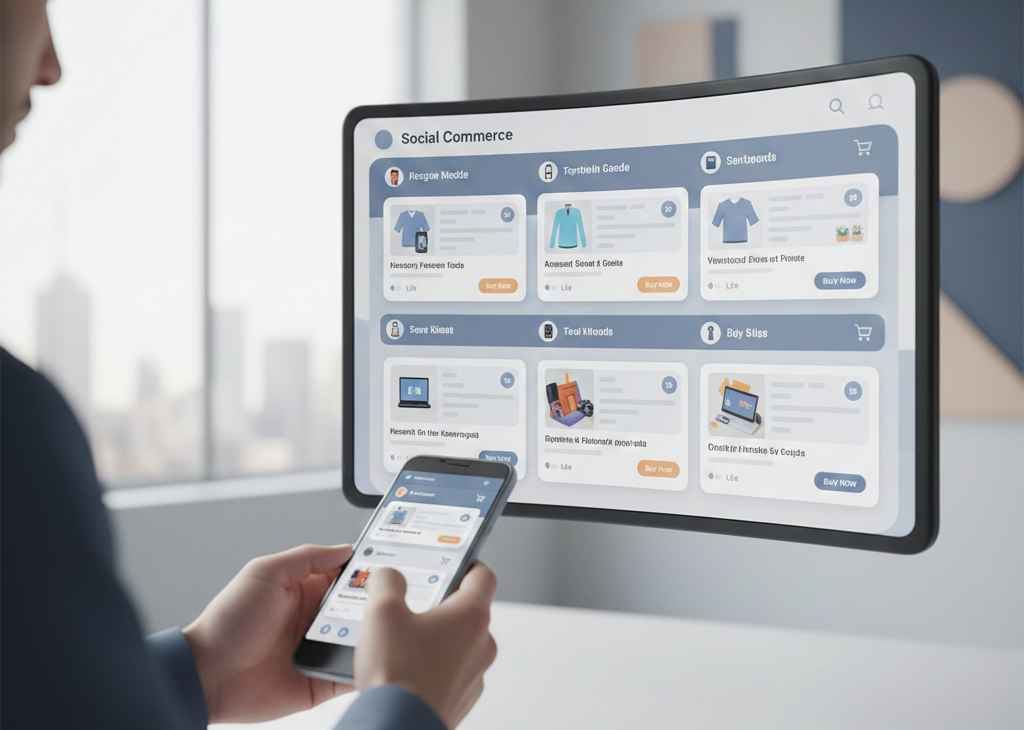
Social media platforms have transitioned into fully integrated marketplaces where the entire journey—from discovery to checkout—happens within a single application. This is a significant part of the e-commerce industry trends that focus on shortening the distance between inspiration and acquisition.
Algorithmic Supply Chain Management
Platforms now utilize predictive AI to analyze trending sounds, visual patterns, and creator behaviors to forecast which items will likely go viral in the coming weeks. This allows brands to adjust their manufacturing and inventory levels before the surge in demand actually occurs. By aligning the supply chain with social signals, companies can avoid the “out-of-stock” disasters that often follow a sudden trend.
The Rise of Livestream Selling
Live commerce has become a global standard for engagement. High-production livestreams hosted by creators allow for real-time interaction, where viewers can ask questions about a product and see it demonstrated live. These events are designed with one-tap checkout features, ensuring that the emotional high of the live experience is immediately translated into a transaction without the user ever leaving the video feed.
5. Circular Economy & Digital Product Passports
Consumer demand for sustainability has reached a tipping point, leading to the integration of the circular economy directly into the retail experience. This shift is one of the most prominent ecommerce trends currently reshaping the global market.
The Role of Digital Product Passports
Many regions have now implemented regulations requiring a Digital Product Passport (DPP) for consumer goods. These are smart labels or QR codes that store a product’s entire lifecycle data, including its material composition, the carbon footprint of its production, and instructions for repair or recycling. This level of transparency builds incredible trust, as consumers can verify the ethical claims of a brand with a single scan.
Integrated Resale Marketplaces
Forward-thinking brands are no longer ignoring the secondary market; they are owning it. By launching integrated “re-commerce” platforms, businesses allow their customers to trade in used items for store credit. This keeps the customer within the brand ecosystem and ensures that products are refurbished and resold rather than ending up in a landfill. It transforms the purchase from a one-time event into a long-term relationship centered on the value and longevity of the product.
6. Multi-Modal Search (Visual & Voice)
The way people search for products is becoming increasingly non-textual. Visual and voice search have moved from being experimental features to being the primary way many demographic groups interact with the web.
Visual Search and Image Recognition
Consumers are now accustomed to taking a photo of an item they see in the real world and having an AI instantly find the product—or a similar alternative—online. This has led to a massive shift in how product imagery is managed. Brands must ensure that their visual assets are not just high-quality but are tagged with rich metadata that allows image recognition engines to identify specific textures, patterns, and features instantly.
Voice Commerce and Answer Engine Optimization
As smart home devices become more integrated into daily life, voice commerce is becoming the preferred method for repetitive purchases and simple queries. This has necessitated a move from Search Engine Optimization (SEO) to Answer Engine Optimization (AEO). In this context, brands strive to be the “single best answer” provided by a voice assistant. This requires content that is conversational, authoritative, and structured to be read aloud by an AI.
7. Embedded Finance & A2A Payments
Checkout friction is being eliminated through the rise of embedded finance, which integrates banking and payment services directly into the shopping journey. These ecommerce future trends are focused on making the actual act of paying as invisible as possible.
Account-to-Account (A2A) Transactions
Traditional credit card networks are facing competition from A2A payments, which use open banking protocols to transfer funds directly from a consumer’s bank account to the merchant. These transactions are faster, more secure, and carry significantly lower fees for the retailer. For the consumer, it means an instant, biometric-authenticated checkout without the need to enter card details or wait for 3D-secure redirects.
Maturation of “Buy Now, Pay Later”
Financing is no longer a third-party add-on; it is a native feature of the digital wallet. Regulated and transparent installment plans are presented as a standard option at the point of sale, allowing customers to manage their cash flow with ease. This integration increases the average order value by making high-ticket items more accessible through clear, interest-free payment schedules that are managed directly within the retailer’s app.
8. Hyper-Local & Micro-Fulfillment
The expectation for delivery speed has reached its logical conclusion: the 60-minute window. This is a core component of e-commerce industry trends in 2026 where logistics is used as a primary competitive advantage.

Urban Micro-Fulfillment Centers
To achieve near-instant delivery, brands are moving their inventory into Micro-Fulfillment Centers (MFCs). These are small, highly automated storage hubs located in the heart of urban areas, often in repurposed retail basements or “dark stores.” By keeping the most popular items within a few miles of the majority of their customers, retailers can bypass the delays of traditional regional distribution centers.
The Last Mile Revolution
The final leg of the delivery journey is increasingly being handled by autonomous ground robots and drones. These technologies are particularly effective in dense urban environments where traffic can make traditional van delivery slow and expensive. By automating the last mile, businesses can offer rapid delivery services that are both cost-effective and environmentally friendly, meeting the high demands of the “instant-gratification” consumer base.
9. Zero-Party Data & Privacy-First Marketing
In a world where third-party tracking has been largely dismantled by privacy regulations and browser updates, brands are finding new ways to understand their customers through direct, consensual data sharing.
The Value Exchange for Data
Zero-party data refers to information that a customer intentionally and proactively shares with a brand. This might include their style preferences, skin type, dietary restrictions, or even their future purchase intentions. To encourage this sharing, brands are creating gamified “preference centers” where customers provide data in exchange for tangible benefits, such as deeply personalized discounts or early access to specific product categories.
Building a Consent-Based Relationship
This shift marks the end of “surveillance marketing.” Instead of trying to guess what a customer wants based on their “cookies,” brands are simply asking them. This leads to much higher marketing accuracy and builds a foundation of trust. When a consumer knows exactly why their data is being used and sees the direct benefit in the form of a better shopping experience, they are much more likely to remain loyal to that brand over the long term.
10. Composable “Headless” Architectures
The technical backbone of online retail has moved away from monolithic, “all-in-one” platforms toward a modular, API-driven approach known as Composable Commerce.
Decoupling the Frontend and Backend
By separating the user interface (the “head”) from the functional logic of the store (the “body”), businesses gain unprecedented agility. They can update the design of their mobile app or web storefront without touching the complex database or checkout logic. This “headless” approach allows brands to be truly omnichannel, delivering a consistent experience across smartwatches, social platforms, and VR headsets simultaneously.
The Lego-Style Tech Stack
Composable commerce allows a business to pick and choose the “best-of-breed” tools for every specific function. A retailer can use one specialized provider for their search engine, another for their loyalty program, and a third for their payment processing, all connected via APIs. This prevents “vendor lock-in” and ensures that as new technologies emerge, they can be integrated into the existing system with minimal disruption, keeping the business at the cutting edge of technological development.
Summary
The transformation of the online shopping world is not just a change in technology; it is a change in the fundamental relationship between the brand and the individual. As automation takes over the logistical and transactional tasks, the value of a brand will increasingly be found in its ability to offer authenticity, community, and ethical transparency. Staying ahead of these ecommerce business trends in 2026 is no longer an optional strategy for growth—it is a mandatory requirement for survival in a world where the customer’s expectations are moving as fast as the technology that serves them.